Farah M.
  • EFL Teacher-Researcher
  • Curriculum & Materials Designer
  • Game Designer · 3× Global Game Jam top placements
  • Taichung, Taiwan

Farah M.

Teaching Language Through Play, Code, and Research

MA TEFL candidate, Tunghai University · expected May 2027

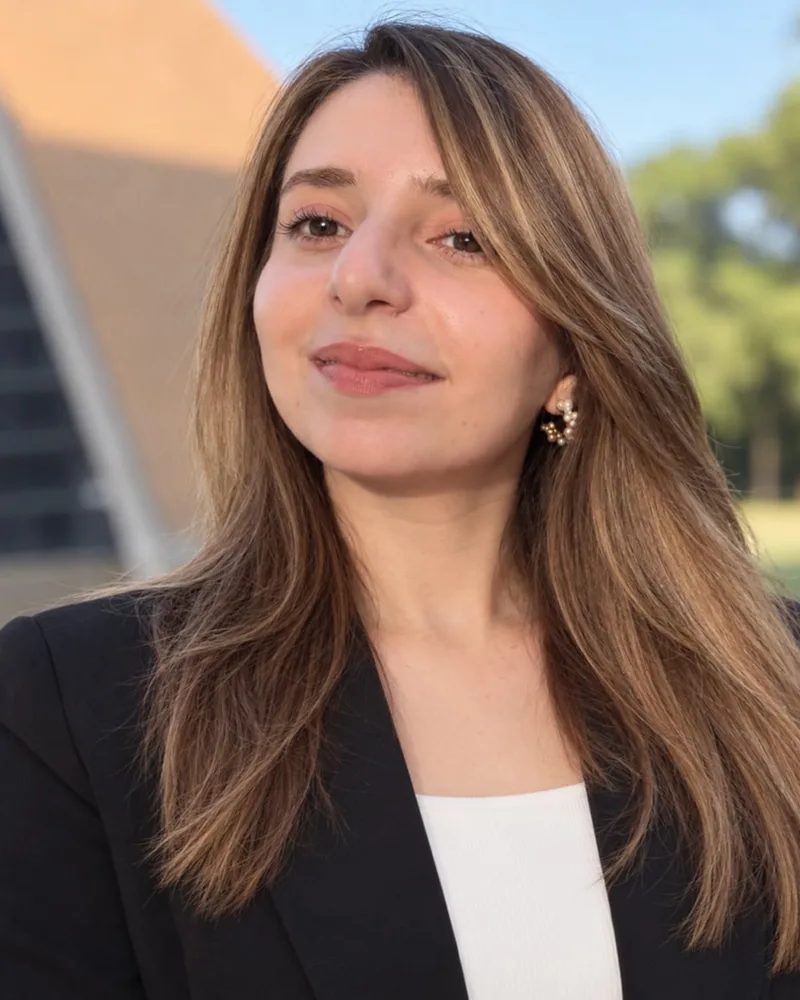
Portrait of Farah M.

About

Who I am

I’m an EFL teacher-researcher based in Taichung, Taiwan, and an MA TEFL candidate at Tunghai University. I teach English and science in English to Grades 1–6, design the curriculum, materials and games I use, and study what helps children learn new words and keep them.

I came to language teaching from computer science and game development. Before Taiwan, I taught children aged 6–17 in Tunisia to build their own games, worked as a level artist and 3D artist, and designed and built a research game for children with ADHD. That background is why I build my own research instruments and classroom tools rather than only using them.

I’m also a language learner myself. I grew up bilingual in Arabic and French, teach in English, and reached B1 in Mandarin as an adult in Taiwan, which keeps me close to the learner’s side of the problems I study.

Where this goes next: a PhD, and a research programme on how songs, games, images or AI tools can help young learners — and how teachers can build those tools themselves.

Teaching philosophy

“What the child can do in cooperation today he can do alone tomorrow.”
— Lev Vygotsky, Thought and Language (1934/1986)

Every lesson I plan starts from that idea: a clear goal, scaffolding that fades as learners take over, and enough play that they want to come back. My research asks the same question with data — which kinds of support help children remember, and for how long — and I want to keep asking it with songs, games, images and AI tools, in the classroom and in the lab.

Research

Research

Current research

Pilot study completed · Proposal approved · Main-study data collection in progress

MA thesis

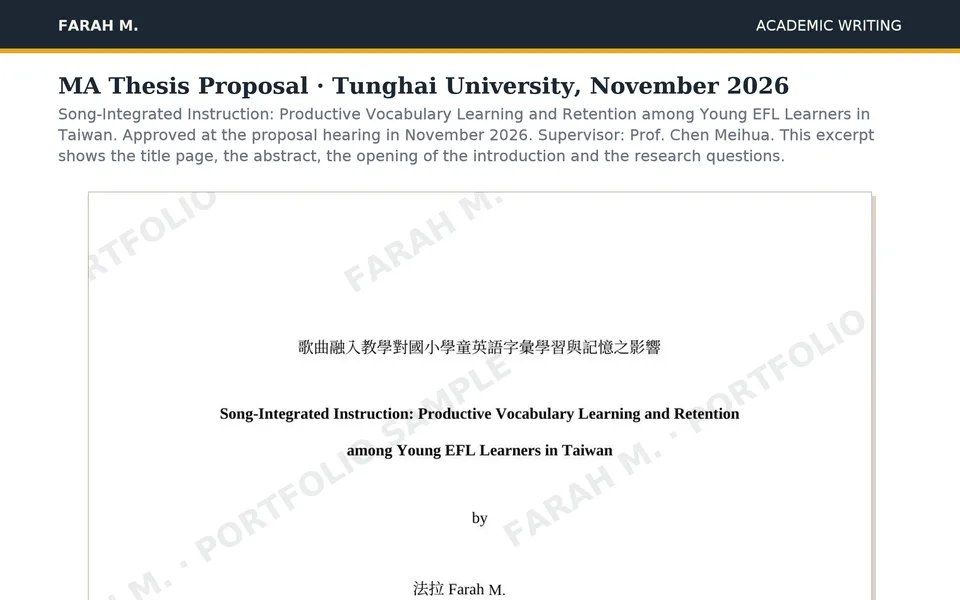
Song-Integrated Instruction: Productive Vocabulary Learning and Retention among Young EFL Learners in Taiwan

Do Grade 4 EFL learners remember new words better when they learn them through songs or through flashcards — and does the difference last? A within-participants study with the 15 learners of one Grade 4 class: each child learns ten words through song-integrated instruction and ten through flashcards, and is tested on productive recall immediately and at 2 and 7 weeks.

Most song-based vocabulary studies with children measure recognition only. This one measures what learners can produce, and whether it survives seven weeks.

Supervisor: Prof. Chen Meihua

Design
Within-participants crossover. Twenty target words confirmed unknown at pre-test, matched in pairs by difficulty, randomly assigned to condition; equal time, alternating order, six sessions.
Learners
15 learners, one Grade 4 class, private English language center, Taiwan.
Measures
Definition-cued recall and sentence production, scored independently by two raters; pre-test, immediate, 2-week and 7-week post-tests; learner questionnaire.
Analysis
Wilcoxon signed-rank with Holm correction; rank-biserial effect sizes with bootstrap confidence intervals.

The study at a glance

Click a step to open it

Study design · 15 Grade 4 learners, 20 target words
  • Song-integrated instruction (10 words)
  • Flashcard instruction (10 words)
  1. Pre-test
  2. Instruction6 sessions
  3. Immediate post-test
  4. Delayed post-test2 weeks later
  5. Delayed post-test7 weeks later

Every learner is taught with both methods, on different words, in the same six sessions. A short questionnaire one week after the immediate post-test asks how they experienced each method.

Main study. The pilot used 2- and 9-week delayed tests.
Future research

My thesis, my case study of AI writing feedback, and my work building games and classroom tools are the three foundations of what I want to study next. My core doctoral interests are multimodal vocabulary learning, game-based retention, and AI-supported assessment. Two related interests grow out of the same work.

  • MA thesis
  • AI feedback case study
  • Teaching and game design

PhD research programme

  1. Core doctoral interests
  2. Multimodal vocabulary instruction

    Why: my thesis isolates one mode, song. The next question is which modes, in which combinations, help children retain words longest.

    First study: a counterbalanced within-participants comparison of song, picture and gesture conditions with Grade 3–5 learners, using the productive measures and delayed post-tests from my thesis.

  3. Game-based learning and retention

    Why: I build vocabulary games for my own classes, but I have only measured them as a teacher. I want to measure them as a researcher.

    First study: one of my games against flashcard practice on matched word sets, with productive recall at 2 and 7 weeks as the retention measure, and in-game behaviour logged to see what predicts what learners remember.

  4. AI-supported feedback and assessment for L2 writers

    Why: my case study showed three undergraduates accepting, rejecting and modifying ChatGPT feedback in different ways. The open question is how younger learners use such feedback and how teachers mediate it.

    First study: how upper-primary learners and their teachers use AI-generated feedback on short writing, whether it changes revision quality against a rubric, and how consistent the AI’s judgements are with human scoring.

  5. Related interests
  6. Teachers as designers of learning technology

    Why: as a teacher I build my own classroom tools, and in Tunisia I taught children to build theirs. Most research treats teachers as users of technology, not makers.

    First study: a design-based study with a small group of EFL teachers who build and classroom-test their own vocabulary games, measuring both learner outcomes and the teachers’ design decisions.

  7. Learning technology for neurodivergent learners

    Why: I designed and built a research game for children with ADHD at the University of Manouba, down to interface and colour decisions for attention.

    First study: a comparison of interface designs for a vocabulary game with children with and without attention difficulties, measuring time-on-task and recall.

Research strands

  • 2025–present

    Vocabulary acquisition

    Pilot and main study on song-integrated vs flashcard instruction with Grade 4 learners (see above). Instruments — vocabulary tests, scoring rubric, learner questionnaire — developed and piloted by me.

  • Spring 2025

    AI feedback on L2 writing

    Case Studies on EFL Students’ Use of ChatGPT Feedback. A multiple-case study of how three Taiwanese undergraduates accepted, rejected or modified ChatGPT feedback when revising argumentative essays, and whether their rubric-based scores improved. Includes per-student findings, the scoring rubric and inter-rater results. Written for Theory and Practice of Teaching Composition, Tunghai University (Prof. Kai-Lin Wu).

  • 2022

    Serious game for children with ADHD

    Designed and built the complete game for a University of Manouba research project: concept, level and interaction design, code, and the interface decisions — placement, colour and iconography — made to suit children with attention difficulties.

Presentations

  • Poster · 2026 TaiwanCALL & GLoCALL Joint Conference, Tunghai University, Taichung, Taiwan · May 8, 2026

    Song-integrated instruction to enhance Taiwanese primary EFL learners’ vocabulary gains and retention

Research interests

  • Multimodal instruction: songs, images and movement
  • Vocabulary acquisition and assessment in young EFL learners
  • Game-based and AI-supported language learning
  • Teachers as designers of learning technology
  • Classroom-based experimental research

Classroom & studio

Experience

  1. May 2024 – present

    DSE School

    English Language & Exam Preparation Center, Taichung

    English & Science Teacher, Curriculum Developer

    An English language center that prepares mainly young learners, plus some adults, for Cambridge English exams, GEPT, TOEIC, TOEFL and Taiwan’s national exams.

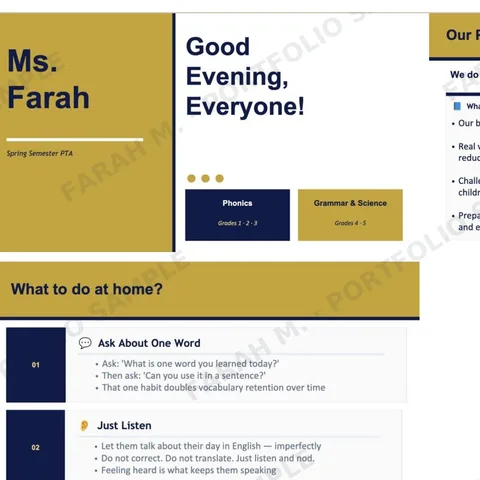
    • Teach English, and science in English, to Grades 1–6, plus speaking and fluency classes for adults
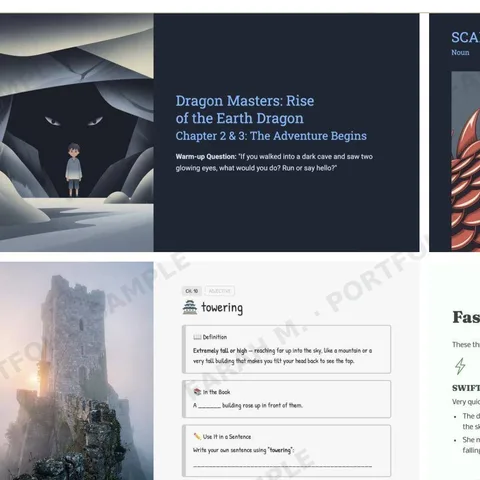
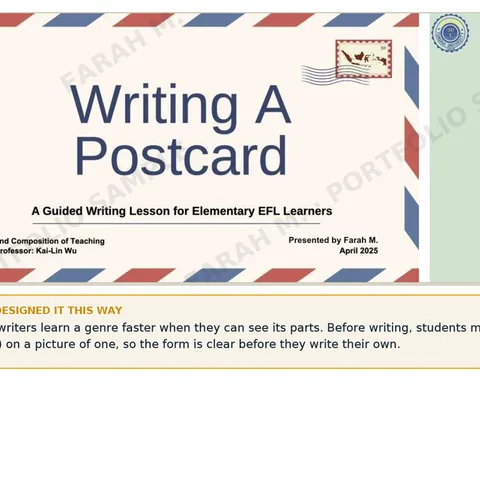
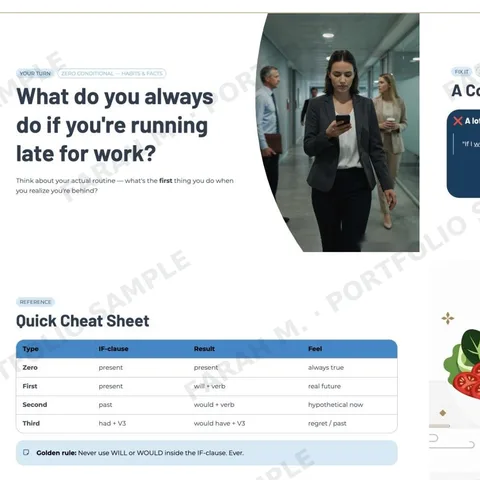
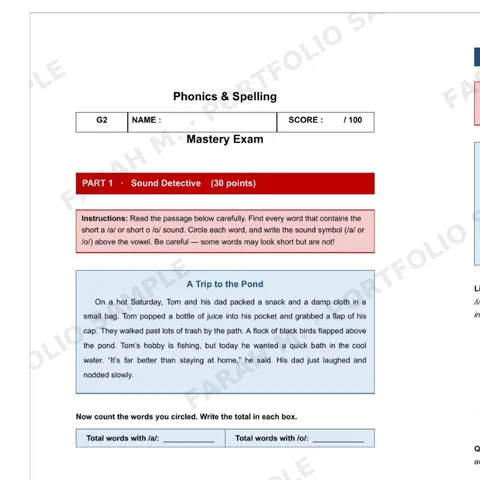
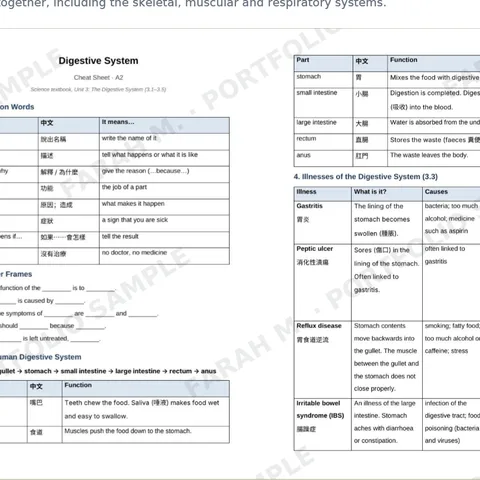
    • Select coursebooks and extend them with my own materials: educational games, worksheets, slides and assessments
    • Designed the “Story Studio” course for Grades 1–2 from scratch: curriculum, materials and lessons
    • Prepare learners for GSAT English and Cambridge B1/B2 exams, including scoring writing against exam criteria
    • Meet with parents and write regular feedback on each learner’s progress
  2. Nov 2024 – Jan 2025

    Washington Bilingual School

    Elementary International Department, Taichung

    Long-term Substitute Teacher, STEM and English

    • Taught daily across science (Grades 4 and 6), math (Grades 1, 3 and 4), English, reading and creative writing
    • Taught every subject in English in a bilingual school setting
    • Repeatedly called back to cover classes across grade levels
  3. 2021 – 2023

    The Young Coders

    Bizerte, Tunisia

    Coding and Game Development Teacher

    • Taught complete beginners aged 6–17 to build their own hyper-casual games in Unity and C#
    • Taught level design and Arduino electronics projects
    • Ran hands-on workshops, monthly assessments, and progress reports for parents
  4. 2021 – 2023

    Game studios, Tunisia

    Level Artist, Lanterns Studio, Tunis (Feb – May 2023) · 3D Artist, CGI Studio, Menzel Temime (2021 – 2022)

    Portfolio on ArtStation ↗

Awards and honors

  • International Student Scholarship

    2024–2026

    Tunghai University

  • Global Game Jam: Top Placements

    2021, 2022, 2023

    Top placements 2021, 2022 and 2023 as story writer, level artist and game designer. 3rd place, Tunisia site, 2022.

Studies

Education

  • MA in Teaching English as a Foreign Language (TEFL)

    Tunghai University, Taichung, Taiwan

    Sep 2024 – May 2027

    Ranked 1st in class, 2025–2026 academic year (GPA 4.18/4.3). Thesis: Song-Integrated Instruction: Productive Vocabulary Learning and Retention among Young EFL Learners in Taiwan (supervisor: Prof. Chen Meihua). Relevant coursework: L2 Vocabulary Acquisition, Teaching and Assessment (A+); English Teaching Methods (A+); Research Methods in Applied Linguistics (A); Assessment and Testing in Foreign Language Learning (A).

  • Mandarin Chinese Language Program

    Chinese Language Center, Tunghai University, Taichung

    Sep 2023 – Aug 2024

    Completed three terms; reached B1 (certified).

  • BSc in Computer Science (Video Game Development), with highest honors

    Dept. of Computer Science and Multimedia, Higher Institute of Multimedia Arts of Manouba, University of Manouba, Tunisia

    June 2023

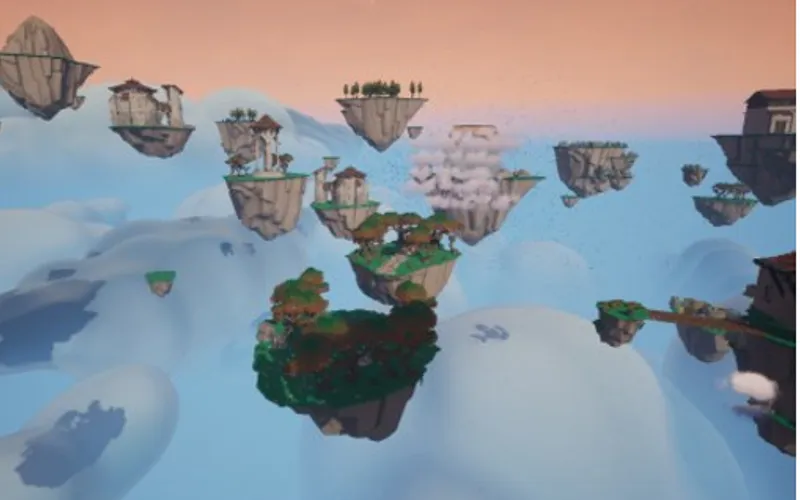
    Final-year project: Heavenly Fury (game design and development).

  • Baccalaureate in Mathematics

    Tunisia

    2019

Toolkit

Skills & languages

Teaching

Curriculum design, assessment design, materials development, young learner instruction, exam preparation, adult fluency coaching

Research methods

Within-participants and crossover design, vocabulary test development and piloting, two-rater scoring and inter-rater agreement, non-parametric testing with effect sizes and bootstrap CIs, multiple-case study, R, SPSS, Excel

Development

Python, JavaScript, HTML, C#, Unity, Arduino

Creative

Game design, narrative writing, level design, 3D environment art

Languages

  • Arabicnative (bilingual)
  • Frenchnative (bilingual)
  • EnglishC1
  • MandarinB1 (certified)
  • ItalianA2
  • TurkishA1

Writing

Blog

Notes on Teaching and Research

Short pieces on what I notice in the classroom and what the research says about it.

  • Designing Lessons Like Game Levels: Goals, Difficulty and Feedback3 min readRead the post

    Before I taught my first English lesson in Taiwan, I spent years building games. I studied computer science with a specialization in video game development, wrote stories and designed levels for game studios in Tunis, and competed in three Global Game Jams. For two years, until I left Tunisia, I taught kids to build their own games in Unity and C#.

    That last job changed how I think about learning. When kids are building something they care about, they don’t need to be pushed. They debug the same line of code ten times and ask for harder challenges. I kept asking myself why a classroom so rarely feels like that. Game designers have spent decades working out how to keep people engaged with something difficult, and most of it applies to teaching.

    A clear goal

    A good level tells you what you’re trying to do. You might not know how yet, but you know what success looks like. Many lessons skip this. Students copy words without knowing why. So I start a lesson by showing the target: “By the end of today, you can ask a friend what they’re doing and answer them.” It’s a small thing, but kids work differently when they can see the finish line.

    Difficulty that rises slowly

    The first level of a well-made game teaches one thing. The second level adds one more. Nobody gets every mechanic at once. I build my grammar decks the same way. For phrasal verbs, I start with one slide explaining that a phrasal verb is a verb plus a small word. Then students see one phrasal verb at a time and guess its meaning before I reveal it. By the end they’re handling ten, but they never had to handle ten at once.

    Fast feedback

    Games tell you right away when you’ve made a mistake. Worksheets usually tell you a week later, when you’ve already forgotten what you were thinking. That’s why I build my own HTML vocabulary games. Students know immediately if they got it right, and they try again on the spot, which is when the learning happens.

    A reason to care

    Players forgive a lot when they care about the story. Learners do too. A word inside a story or a song has something attached to it: a character, a feeling, a melody. A word on a list has nothing. This idea led me to my current research on songs and vocabulary.

    Pacing

    Good games alternate tension and rest: a hard section, then a calm one. A 50-minute lesson needs the same rhythm. I plan lessons in short blocks: something new, then practice, then movement or a game, then something new again.

    What doesn’t carry over

    I’m careful with one thing. Points, badges and leaderboards aren’t game design. They’re the wrapping, not the gift. A boring activity with points attached is still a boring activity. What makes games work is the structure underneath: clear goals, a fair challenge, quick feedback and meaning. Those are what I try to bring into every lesson.

    I don’t build games for studios anymore. But I still design every lesson the way I used to design a level: what does the player need to learn here, and how do I make them want to keep going?

  • Songs or Flashcards? Inside My Vocabulary Study with Grade 4 Learners3 min readRead the post

    Every English teacher of young learners knows this moment. You teach ten new words on Monday. On Wednesday, half of them are gone. Then a student starts singing a song you taught months ago, and every word is still there, with perfect pronunciation.

    I kept noticing this in my own classes, and it became the starting point for my MA thesis at Tunghai University: Song-Integrated Instruction: Productive Vocabulary Learning and Retention among Young EFL Learners in Taiwan.

    Why songs might help

    Researchers in vocabulary learning have long argued that learners need to meet a word many times, in context, before they really know it. Songs build that repetition in naturally. A chorus might use the same word eight times in two minutes, and children don’t experience that as drilling. They experience it as singing.

    Songs also give language a shape. Rhythm and melody break sentences into chunks that are easier to hold in memory. And songs carry emotion. Children remember things they enjoyed.

    But “kids like songs” isn’t evidence. Plenty of classroom activities are fun and don’t lead to much learning. I wanted to test it properly.

    What I’m studying

    My study works with Grade 4 EFL learners in Taiwan and compares two ways of teaching vocabulary: song-integrated instruction and flashcard-based instruction. Flashcards are a fair comparison because they’re one of the most common methods in Taiwanese classrooms, and they work.

    The study uses a crossover design. Each learner studies 20 target words: 10 through songs and 10 through flashcards, in the same six sessions. That way every child experiences both methods, and the comparison doesn’t depend on one class simply being stronger than another. Learners are tested before the lessons, right after them, and again two and seven weeks later.

    I’m focusing on two things:

    • Productive vocabulary. Can students actually use the word, by saying or writing it? Recognizing a word on a multiple-choice test is much easier than producing it, and production is what children need to communicate.
    • Retention. Do they still know the word weeks later? Learning something for Friday’s quiz and keeping it are not the same.

    A pilot study earlier this year helped me test the materials and the vocabulary tests. Data collection for the main study is now in progress, so I’m not sharing results yet. I’ll write about them once the study is finished.

    What I’d tell teachers now

    Even before the results, here’s what I’ve learned from designing song-based lessons:

    • Choose songs for the words, not the other way around. The target words should be repeated, clear and sung slowly enough to hear.
    • Add actions. Movement gives younger learners another way to remember, and it keeps the whole class involved.
    • Don’t stop at singing. Follow the song with a speaking or writing activity where students use the words outside the song. Otherwise they may only be able to produce them inside the melody.
    • Songs aren’t magic. They’re one tool. Flashcards, games and reading all have a place. The question my research asks isn’t “songs or nothing” but which method helps which kind of learning.

    I chose this topic because it sits where my two worlds meet: the teacher who wants children to remember, and the game designer who knows that rhythm, repetition and emotion keep people engaged.

  • What Building a Game for Children with ADHD Taught Me About Classroom Attention3 min readRead the post

    In 2022, while I was studying video game development in Tunisia, I joined a university research project to build a serious game for children with ADHD, under faculty supervision. At the time I saw it as a design challenge. Looking back, it was one of my first lessons in teaching.

    A quick note first: I’m a teacher and a designer, not a clinician. ADHD looks different in every child, and nothing here is medical advice. This is about what designing for attention taught me, and how it changed the way I build lessons for every student.

    Lesson 1: Short tasks with a visible end

    A long task with no clear end is hard for almost anyone to start. In the game, we broke activities into short rounds, and the player could always see how much was left. In my classes, I do the same. Instead of “complete this worksheet,” students get one section at a time, and they can see where they are.

    Lesson 2: One instruction at a time

    Three instructions given at once often become one instruction remembered. In a game, you can’t give the player a paragraph of rules, so you show one step and let them do it. Now I give one instruction, check that everyone has started, and then give the next. I show it on the screen as well as saying it.

    Lesson 3: Less on the screen

    Every extra element on a screen competes for attention. A cluttered game interface makes players miss the one thing that matters. Slides work the same way. My slides usually show one idea, one word or one question. My worksheets use large fonts and plenty of space. They look simple, and that’s the point.

    Lesson 4: Feedback right away

    Waiting is hard. A game responds the moment you act. When feedback is delayed, the connection between the action and the result gets weaker. In class, this means checking answers together during the activity, not days later, and using quick games that show right away whether an answer is correct.

    Lesson 5: Movement can be part of the task

    Many children find sitting still for a long time difficult. In a game, movement is the activity. In a classroom, it can be too: acting out vocabulary, moving to the right corner of the room to answer, or adding gestures to a song. Movement doesn’t have to be a break from learning.

    Lesson 6: Predictable structure

    Routines reduce the effort of figuring out what’s happening next. Players learn a game’s rules once and then focus on playing. My lessons follow a familiar shape, so students spend less energy on “what are we doing now?” and more on the language.

    Good for everyone

    The biggest thing this project taught me is that designing for the children who find focusing hardest usually makes things better for everyone. Clear instructions, clean materials, quick feedback and a bit of movement don’t help only one group of students. They help the whole class. When I design a lesson now, I picture the student who’s most likely to get lost, and I design for them first.

  • Why My Students Still Say “She Do”: Lessons from Learning Mandarin as an Adult3 min readRead the post

    When I moved to Taiwan in 2023, I spent a year studying at Tunghai University’s Chinese Language Center and reached B1 in Mandarin. I grew up bilingual in Arabic and French, and I speak English at a native level. I thought I knew what language learning felt like.

    Mandarin reminded me how it feels to be a real beginner. It was humbling, and it’s made me a better teacher.

    Listening is exhausting

    In my first months, a 50-minute class left me more tired than a full day of work. Following a language you only half understand takes enormous effort. Now when a child looks distracted in the last ten minutes of English class, my first thought isn’t “they’re not trying.” It’s “they’re tired, because this is hard.”

    “Easy” depends on who’s reading

    As a teacher, it’s easy to look at a text and think it’s simple. As a learner, I found that one unknown word in a sentence could block the whole meaning. I see the same thing with my students. Many young learners in Taiwan struggle even with A2-level books. What feels easy to the teacher often isn’t easy for the student. Real comprehension needs material where almost every word is already known.

    Knowing a rule isn’t the same as using it

    I can explain Mandarin tones perfectly. I still get them wrong when I’m speaking quickly. That helped me understand something I see every week: Grade 5 and 6 students who have studied subject-verb agreement for years still say “she do” in conversation. They know the rule. Using it automatically while speaking takes much more practice than learning it, and correcting them harder doesn’t speed that up. Meaningful practice does.

    The same word, many times

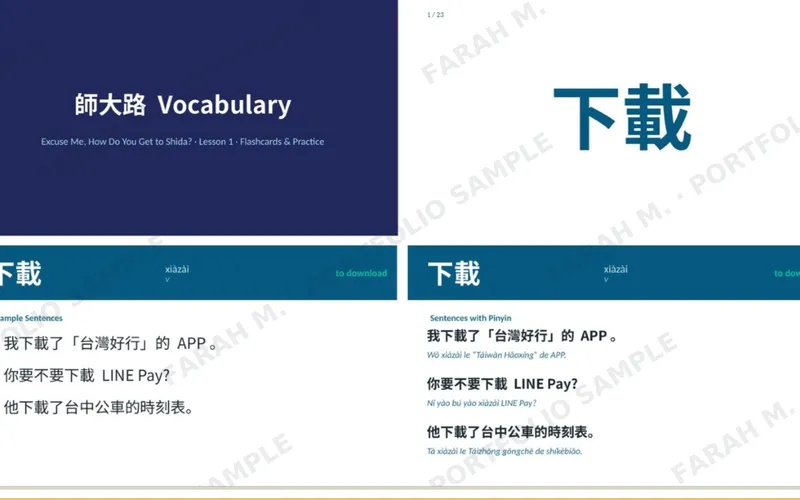
    I learned Mandarin vocabulary best when I met a word in several different sentences, not just once on a list. So I made my own study slides: first the word alone, then its meaning and pinyin, then three short everyday sentences that use it. It worked so well for me that I now use the same structure for my students’ English vocabulary.

    Speaking needs safety

    I remember the feeling of knowing the words but not being able to make them come out, because people were waiting. Children feel this even more. So in my classes I give sentence frames to build on, give students time to think before they answer, and let them practice with a partner before speaking in front of everyone.

    Every language teaches something

    Arabic, French, English, Mandarin, and a little Italian and Turkish: each one taught me something different about learning. Mandarin taught me the most, because I learned it as an adult, while teaching, in the country where it’s spoken. I still stand on both sides of the classroom, as a teacher and as a learner. I think that’s the best training a language teacher can have.

Contact

Let’s talk about language and learning.

I welcome conversations about young-learner vocabulary research, classroom-based experiments, learning-game design, and PhD opportunities in applied linguistics and CALL.

  • مرحبا
  • Bonjour
  • Hello
  • 你好
  • Ciao